
Basic Principles of Wound Care
- 13
- Oct
- 2014
There are three basic principles which underlie wound healing.
1. Identify and control as best as possible the underlying causes.
2. Support patient centered concerns
3. Optimize local wound care.
The CAWC Best Practice Recommendations for wound care (wound bed prep, venous ulcer management, pressure ulcer management and diabetic ulcer management) extensively covers all three principles (www.cawc.net).
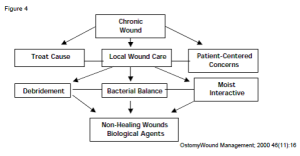
Figure 4,2 excerpted from Wound Bed Preparation, outlines an algorithm that provides a framework for chronic wound management.
Optimize Local Wound Care
In 1962 George Winter described improved wound healing under moist conditions7. Despite that seminal work it is only in the last decade that the advantages of moist interactive wound healing have become more widely recognized
and applied in clinical practice. Some of the advantages include the following:
Decreased dehydration and cell death. As described earlier, the task of wound repair requires the activity of a host of cells from neutrophils and macrophages to fibroblasts and pericytes. These cells cannot function in a
dry environment.
Increased angiogenesis. Not only do the cells required for angiogenesis require a moist environment but also angiogenesis occurs towards regions of low oxygen tension such that occlusive dressings may act as a stimulus
in the process8.
Enhanced autolytic debridement. By maintaining a moist environment neutrophil cell life is enhanced and proteolytic enzymes are carried to the wound bed allowing for painless debridement9. Further as discussed earlier
these fibrin degradation products are a factor in stimulating macrophages to release growth factors into the wound bed.
• Increased re-epithelialization. In larger, deeper wounds epidermal cells must spread over the wound surface from the edges. They must have a supply of blood and nutrients. Dry crusted wounds reduced this supply and provide a barrier to migration thus slowing rates of epithelialization 10.
• Bacterial barrier and decreased infection rates. Occlusive dressings with good edge seals can provide a barrier to migration of microorganisms into the wound. Bacteria have been shown to pass through 64 layers of moist gauze11. Wounds covered with occlusive dressings have been shown to have lower rates of infection than those with conventional gauze dressings 12.
• Decreased pain. It is believed that the moist wound bed insulates and protects the nerve endings thereby reducing pain. Furthermore occlusive dressings often require fewer dressing changes, which may be uncomfortable for patients.
• Decreased costs. While occlusive dressings have a higher per unit cost than conventional gauze, the reduced frequency of dressing changes and increased healing rates may proved to be cost effective in the long term.